Diego Ariza
Gente que viene y ¡Bah!Diego Ariza is a businessman and widower whose attempts to sustain the Andrada family’s timber operations unfold alongside private grief and a politically contested development project. First glimpsed through Bea’s wary, often comic observations, he becomes more than the striking figure in a pink Mercedes: he is a father caring for a daughter who does not speak, a son-in-law bound to a bereaved household, and a local operator trying to keep a factory going. His story repeatedly brings private loss into contact with public work—and, eventually, with Bea’s own plans for the estate’s trees.
Identity and First Impressions
Diego lives in the village and runs the sawmill and factory. Bea first notices him in Santander, where he drives a conspicuous pink Mercedes, an old convertible from the 1980s fitted with a canvas cover. Its bubblegum color seems startlingly out of place to her in rainy, traditional Cantabria. The car becomes an identifying detail: she recognizes it later beside the Andrada estate and again when she encounters him elsewhere in town.
Her first impression is shaped as much by appearance as by circumstance. Diego has reddish hair, light eyes, and a dimple in his jaw. When he greets Juan, Bea initially wonders whether he is acknowledging her brother-in-law’s celebrity, only to learn that Diego lives in the village. Bea’s narration sees him as handsome and unusually polished for his surroundings, comparing his look to advertising imagery. That perspective is deliberately partial: Diego first enters the story as a person watched and interpreted by Bea, not as a character whose private thoughts are directly available.
Bereavement and Family Responsibilities
Irene identifies Diego as a capable man and explains the tragedy that has reshaped his household. His wife, Diana, died in a traffic collision at an intersection with a truck the day after obtaining her driving licence. Diego was married to her, and her death left him to raise their daughter, who does not speak. Diana’s mother also suffered a stroke after her daughter’s death and was left nearly immobile. Diego is therefore caring for a child and an impaired mother-in-law while continuing to manage the family’s business.
The account presents these responsibilities not as an abstract backstory but as the conditions under which Diego keeps functioning. Irene emphasizes that, despite everything that has happened, he is still trying to keep the factory going. The pink Mercedes, so conspicuous in Bea’s first description, is parked at the estate while Diego carries a heavy-looking plastic bag to it; Bea watches from a distance, unable to know what he is doing. The scene establishes both her curiosity about him and the limits of what she can see. His grief is disclosed later, through Irene, rather than explained by Diego himself.
Work and the Biomass Project
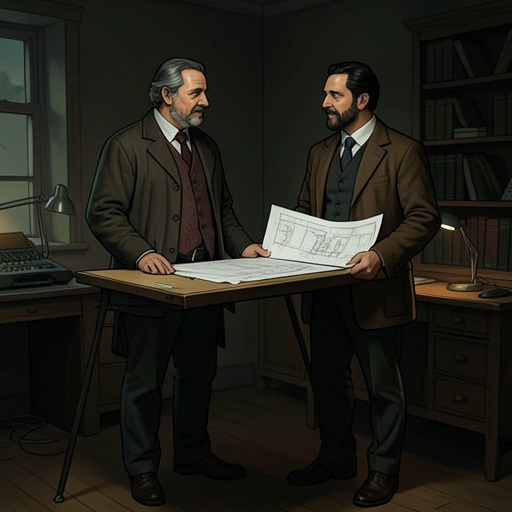
Diego’s work connects him to the Andrada estate and to the village’s arguments over development. Irene describes him as the estate’s son-in-law and says that she and Diego are working closely to make a biomass power plant a reality. The project needs investors from outside the area, and, in Irene’s view, Diego is trying to secure them while keeping the factory operating. Her confidence in his capability sits beside her awareness that the project is unpopular: she expects it to bring her the hatred of much of the village and says she will use whatever shortcuts are necessary to get it done. That is Irene’s declared political resolve; the evidence does not establish that Diego himself chooses or carries out those shortcuts.
His business also appears in smaller, concrete encounters. At a delivery, Diego explains that fir trees have been brought from Álava for a commission. He asks Bea whether she has a particular preference for fir wood and teases her about climbing on the pallet or rolling on the ground, recalling her embarrassing drunken behavior the previous night. The exchange places him at work, handling timber and speaking with confidence, while also showing how quickly Bea’s private embarrassment enters their encounters.
Encounters and Conflict with Bea
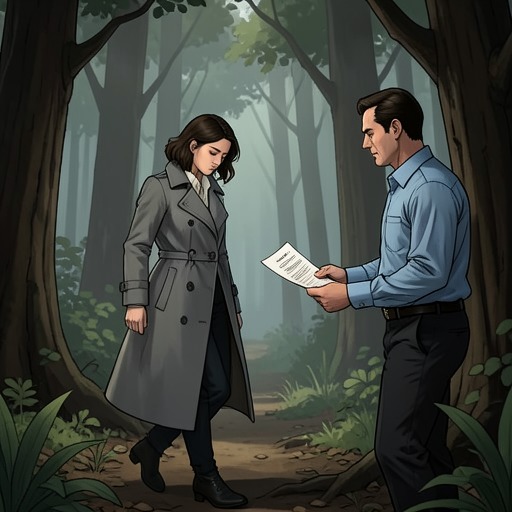
Bea’s first close look at Diego comes after she watches him at the Andrada estate. On a moonlit night, she sees his pink Mercedes parked beside an oak and notices him load a large bag into its trunk. He remains in the car, where she sees him strike the dashboard in anger. Curiosity keeps Bea near the wall despite the risk and despite her barefoot discomfort. When Diego notices her, she steps back, loses her balance, and falls, injuring herself and catching her clothes on a bramble. The encounter begins their connection with a collision between his private distress and her intrusive observation; Bea does not yet know what has brought him to the car.
Later, when Bea has fallen again while chasing a banknote, she sees Diego near the Mercedes with a small pharmacy bag. He watches her as she struggles back to her feet. Bea insists she was not following him that time; Diego’s reply recalls that she had followed him on the earlier occasion. Their exchange turns the first accident into shared knowledge, a source of awkward recognition between them rather than a secret Bea can simply leave behind.
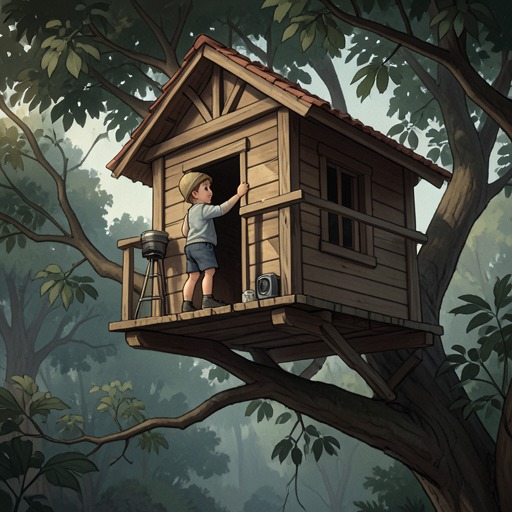
Their relationship also becomes entangled with the treehouse Bea is building. When she confronts Diego during an important meeting, she accuses him of ordering workers to destroy her treehouse because she refused to build his daughter’s first. Diego says he has no idea what she means. The exchange establishes a serious conflict, but not the truth of Bea’s accusation: his denial leaves responsibility unresolved in this scene. For Bea, the threatened work concerns both her project and the chestnut trees; for Diego, her accusation arrives in the middle of his business dealings. Their dispute exposes how the estate’s commercial authority can collide with Bea’s architectural work and personal commitments.
Narrative Role and Significance
Diego’s story is framed through the contrast between what the village knows and what Bea discovers by watching him. Irene supplies the facts of Diana’s death, the daughter’s silence, and the injured mother-in-law; Bea supplies the vivid first impressions, the repeated sightings of the pink car, and the uneasy humor of their conversations. The different views do not cancel one another. Together, they show a man whose public work and distinctive appearance are readily visible while the loss that structures his family life must be explained by someone else.
The same contrast shapes his place in the conflict over development. Diego is a capable operator trying to sustain the sawmill and factory, and a partner in Irene’s biomass ambitions, but the evidence also places him on the opposing side of Bea’s treehouse dispute. He is not reduced to a single role: bereaved husband, father, businessman, and contested collaborator in local change coexist. His significance lies in that intersection, where the effort to carry on after personal catastrophe is inseparable from the practical and political choices being made around the Andrada estate.